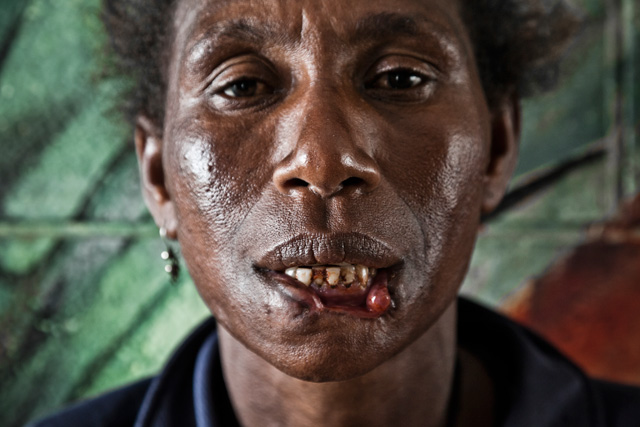
A PNG woman was set alight in Mount Hagen in Papua New Guinea in February after being accused of sorcery. Picture: AFP
Source: AFP
THOSE who appear before magistrates
Rhoda Geita, Rita Bray and Mege Baru must abide by three rules: no
lawyers, no smoking and no chewing betel nut. These women are highly
respected "chairlady" magistrates with Papua New Guinea's village
courts, of which there are more than 1600 in the physically stunning but
often lawless nation.
A PNG woman was set alight in Mount Hagen in Papua New Guinea in February after being accused of sorcery. Picture: AFP
Source: AFP
THOSE who appear before magistrates
Rhoda Geita, Rita Bray and Mege Baru must abide by three rules: no
lawyers, no smoking and no chewing betel nut. These women are highly
respected "chairlady" magistrates with Papua New Guinea's village
courts, of which there are more than 1600 in the physically stunning but
often lawless nation.
All grandmothers, they agree on one thing: "Female magistrates have
to be tough." Baru, who has a don't-mess-with-me demeanour and faint
traditional tattoos on her face and hands, reveals that angry defendants
"do come and threaten me but I don't feel scared. I will threaten them
back."
PNG women are among the world's most disempowered and
abused, and a recent series of gruesome murders of women accused of
witchcraft and sorcery has fed perceptions that gender violence is
worsening. Despite this, the number of female magistrates in the country
has exploded in recent years, partly because of training programs run
by Australia's aid agency, AusAID.
In 2007, there were just 10
female village court magistrates in PNG; today, there are about 900. I
met three veteran female magistrates in Port Moresby earlier this month
while travelling to PNG as part of a delegation of Australian
journalists sponsored by the Department of Foreign Affairs and Trade.
Speaking through a translator, Baru - who speaks several tribal
languages but no English - supports the PNG government's contentious
reinstatement of the death penalty for crimes including murder and
aggravated rape.
"It's a good thing because it is a deterrent," she says. "The police have to do something in order for people to take notice."
PNG's
National Council of Women also supports the death penalty, viewing it
as a remedy to gender violence. "This year, the raping and killing of
women has increased, and we are wondering what has gone wrong," the
council has said. Yet the revived law has been condemned by the UN and
EU, which argue it won't discourage crime; Amnesty International calls
it "barbaric".
In PNG, there are fears innocent people could end up being executed by a justice system that is often inconsistent and chaotic.
Baru
is one of nine magistrates at the Erima Village Court in Port Moresby.
She also works at a police station at the city's notorious Gordons
market, a rundown, outdoor food hub where, she says, murders occur
regularly.
In a country often riven by tribal fighting and
payback-style disputes, village courts play an important role in
maintaining community stability. Geita and Bray have listened to details
of murder cases so that victims' families can be compensated and
further violence avoided - the equivalent of Australian civil cases.
These local courts - which may convene under a tree or on a beach - use
mediation and fines to deal with other issues ranging from unpaid
dowries and land disputes to assault, adultery, theft and the making of
illegal brew.
Emboldened by the presence of female magistrates, a
growing number of women are airing their grievances. Today, about 40
per cent of the claims brought to village courts are made by women.
Geita and Bray tell Inquirer that male magistrates don't always take
women's complaints seriously, and that "women come more openly to us if
there is a woman on the court". On the other hand, these formidable
court officials shake their heads gravely when discussing community
conflict caused by "gossiping women"; they say such offenders can end up
before local courts, accused of defamation.
Getting women a
better deal in their own legal system is a key priority for AusAID.
Women now account for about 8 per cent of magistrates in PNG, while PNG
governments also have promoted women in the legal field: the country's
chief magistrate, solicitor-general and chief ombudsman are women, and
there are two female judges on the National Court.
Last month,
Prime Minister Peter O'Neill officially apologised for the violence
endured by his countrywomen and declared a national day of mourning. But
such progress plays out against a backdrop of continuing, endemic
violence. Studies quoted by the World Bank suggest more than half of PNG
women have been raped, while two-thirds have suffered domestic
violence. One AusAID study showed 100 per cent of surveyed Highlands
women had suffered violence.
During my visit, a single edition of
Port Moresby's Post-Courier newspaper carried stories about three
disturbing crimes, all involving young women and girls. In one, a
19-year-old mother was burned with hot iron rods and left to die in the
bush. The paper also reported on an escalating child sex trade in the
capital.
A third article suggests an eye-for-an-eye philosophy
still prevails in rural areas. This report said a teenage Highlands girl
allegedly beheaded her father with a bush knife after he raped her.
Local leaders agreed she should not be handed over to the police because
her father deserved to die.
Such stories may suggest law and
order has broken down. However, it also may be that in the era of the
mobile phone and social media, violent crimes in isolated areas are
likelier to be exposed. Certainly, Baru believes more people are making
vexatious sorcery allegations, which usually target women and can lead
to murder. In a sorcery killing in February, a 20-year-old woman accused
of witchcraft was burned alive in a crowded market. Baru hopes that
new, hefty fines for those who make false sorcery allegations will make a
difference. So, too, should the recent repeal of the country's Sorcery
Act, under which suspicions of sorcery were used as a defence in murder
cases.
AusAID's emphasis on law and justice is part of a broader
gender rights agenda in PNG. Australia is by far the country's biggest
foreign aid donor, with an annual contribution of about $500 million.
Another
pressing priority for the aid agency is tackling the country's
maternity mortality rate, which is 80 times higher than Australia's.
Australian funds are being used to train 1400 midwives, nurses and
health workers, many of whom will take their skills to villages with no
electricity or roads, let alone a decent hospital.
An important
success story is the containment of a feared AIDs epidemic. Until 2009,
it was predicted that HIV-AIDS would infect 5 per cent of the PNG
population by 2015. But the national rate in 2010-11 was just 0.8 per
cent. (The rate is just above 1 per cent in some Highlands provinces and
in Port Moresby, and is substantially higher again in high-risk groups
such as sex workers). Key to the overall containment, says one local
expert, is the provision of anti-retroviral drugs - paid for by the PNG
government - and effective treatment programs, many of them paid for by
Australia. Australian-funded non-government organisations are treating
almost half the PNG men, children and women - including pregnant women -
known to be HIV positive.
Getting pregnant women on to treatment
is crucial: if an HIV-positive mother-to-be starts drug therapy early
during pregnancy, the risk of her transmitting the disease to her baby
is less than 1 per cent. Last year, Australia paid for more than 31,000
pregnant women to be tested for the disease.
Despite such
tangible outcomes, O'Neill has criticised Australia's aid program for
not focusing more on infrastructure projects such as roads; PNG's roads
are in a shocking state and there aren't enough of them. O'Neill has
said: "We are spreading the development program too thinly. And although
the program is very much appreciated, the effect of it has not been
felt by the population of Papua New Guinea." AusAID head in PNG Stuart
Schaefer rejects these criticisms. "This year Australia will spend $180
million, 37 per cent of our aid program, on infrastructure in PNG,
including on road rehabilitation and maintenance, health centres and
school facilities," he says. He adds that last month O'Neill and Julia
Gillard agreed Australia would work with PNG to plan and cost
infrastructure projects including a highway upgrade and hospital
redevelopment.
But Schaefer is adamant "infrastructure is not the
only priority for the aid program. To lift people out of poverty we
also need to address better service delivery in the priority areas of
education, health, and law and justice." He says Australia's HIV
programs are saving lives and that other aid projects have "delivered
real development results. For example in 2012, we supported the delivery
of essential medicines to more than 2000 of PNG's hospitals, health
centres and aid posts; the vaccination of over 500,000 children for
measles and polio and over 1.2 million women for tetanus."
Then there is the growing cadre of female magistrates.
Geita
says that years ago "it was very hard for women to open up about what
had happened to them. These days, I think that things are getting
better."
Baru agrees, observing: "Sometimes there are things that
ladies can't share with men, and in these cases, it is helpful to have
women magistrates."